A self-assessment measures how you describe the company.
There is no shortage of self-assessment questionnaires, and nearly all of them hand back a level. The difficulty is well known to the people who write them: the company answering is the company being assessed, so the number depends on how it chooses to describe itself. A questionnaire that pretends otherwise promises a measurement and delivers an impression.
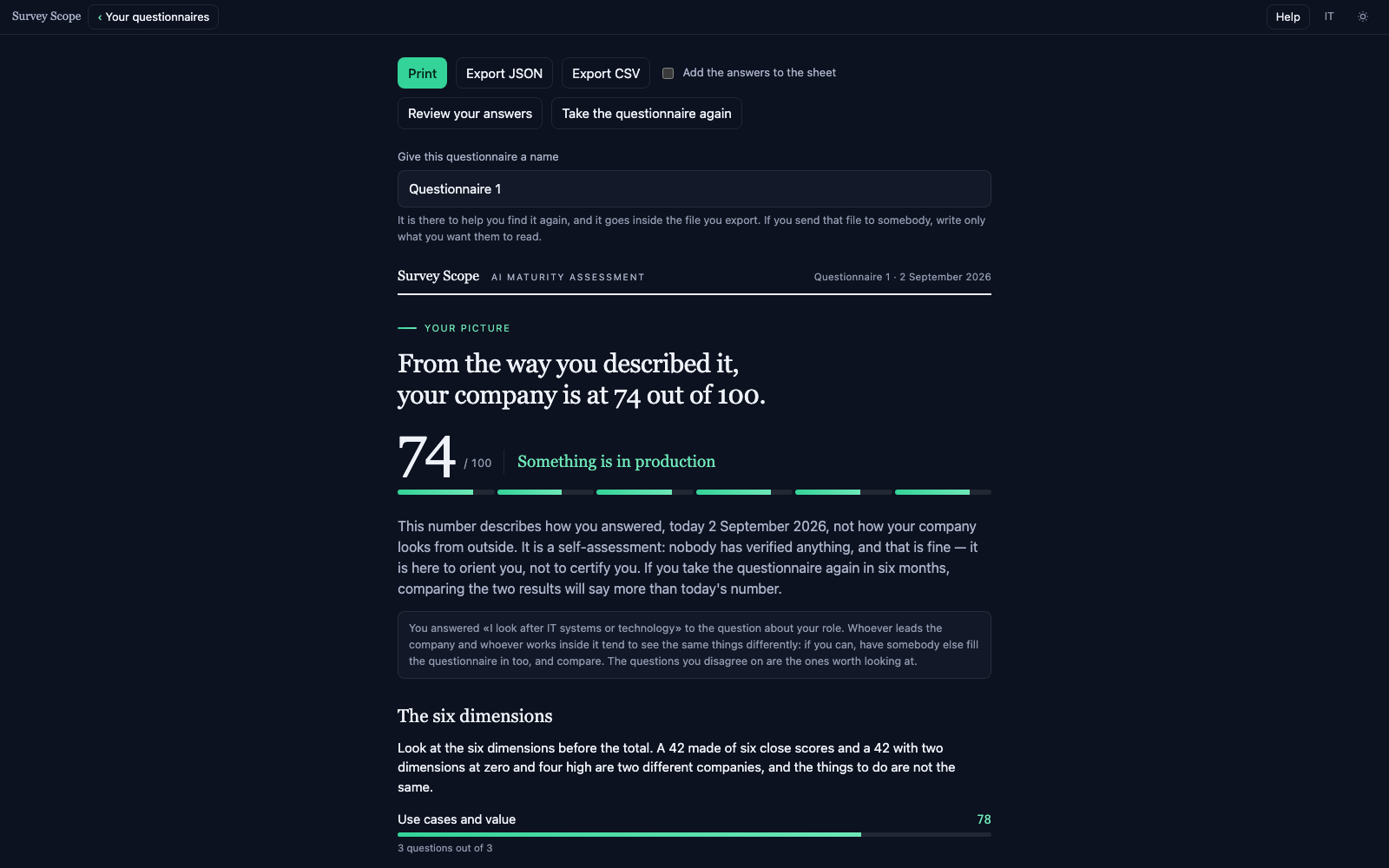
Survey Scope says so in the first line of the report, and then works to make it matter less. Every question asks for something that happened rather than something that persists: not «do you have a procedure», but «the last time something went wrong, who noticed first». An event either happened or it did not, and the person answering can tell which while they answer.
You can read every question: they are JSON files inside the app, one folder per questionnaire, under Apache-2.0. The ones about AI went through three rewrites and three measurements. The same idea underneath our work on artificial intelligence — whoever decides has to be able to check what they are deciding on.
It is also why it is worth handing to several units at once. Twenty runs from the same company show where the departments disagree; twenty runs from different members show where the sector has the same gap. In both cases the useful question is not the average, but how far the answers sit from one another.
What it does
- Two questionnaires, picked at the start: AI maturity, and a NIS2 check. Twenty-two questions each.
- One question per screen, with the answers written out: you choose, you do not compose.
- A score for each of the questionnaire's six dimensions, before the total.
- Three things to start from, taken from the dimensions with the lowest score.
- The European obligations that bear on the questionnaire — fourteen for AI, ten for NIS2 — each with the date it applies from and a link to the text.
- A printable report that stays readable on a black-and-white printer.
- Export as JSON and as CSV, with the fingerprint of the questionnaire edition inside the file. Choose a folder and the results land there by themselves at every change, with one copy a day: inside Dropbox or iCloud, the backup travels on its own.
- Answers are saved at every step: you can stop half way and carry on later.
- An optional deep-dive module, where the questionnaire has one, for anyone who wants to say how they got there.
- Taken again in six months, comparing the two files says more than today's number.
- Give every questionnaire a name and find it again in a list you can search by name or by date.
- Files other people send you load into the same list, and the same file loaded twice stays one row.
- Every file carries the edition fingerprint: if somebody answered a different version of the questions, you can see it.
- Export a questionnaire template as a file, edit it in a text editor and load it back under a different key: it becomes one of the templates you can pick.
- A template you have loaded stays on your computer like everything else, and is removed whenever you like without touching the runs already answered.
What it does not do
- It verifies nothing: no answer is checked by anybody.
- It is not a certification and it is not legal advice.
- It does not compare you against other companies: there is no database behind it, and comparing unverified self-assessments would say nothing.
- It collects nothing on your behalf. There is no server: if you hand it out, the results are sent to you by people and you load them yourself.